There’s been some controversy this year (stoked by that venerable film critic, Roger Ebert) about whether computer games are really “art”. I ’m not going to weigh in on this directly, but tangentially – through the lens of storytelling. Can digital games tell stories which are as compelling and interesting as an epic poem, a novel, or a good movie (let’s call them “passive literature”)? The answer is: yes, they are already, not quite at the level of timeless classic literature just yet. There’s a long way to go, but we could get there in our lifetimes.
I wanted to explore this by reviewing a genre of computer game – the CRPG (computer or console role-playing game). Typically these are single-player games, where the player takes on the role of a defined protagonist in a quest. These are the closest types of games to novels or movies, except that the player can and does make decisions during the game (they don’t just passively sit and watch, or read and turn the page), and often these games run into 40-80+ hours (vs. say a 2-3 hour movie). If we consider the genre as a whole, let’s compare their storytelling elements to the traditional components of a novel’s or movie’s story: plot, structure, characters, theme, setting, style and tone. Then we’ll conclude with some thoughts on how game designers can continue to improve the story and experience of their games.
Plot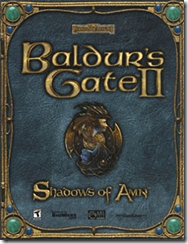

CRPG’s typically have a ‘quest’ plot, described as the ‘Hero’s Journey’ template by Joseph Campbell, The Hero with a Thousand Faces (1949). As the protagonist you start out as a virtual nobody not knowing much about yourself or what’s going on, and you end up being caught up in big events and eventually play a (if not the) key role in changing or saving the world. You need an epic plot to sustain the 40+ hours of gameplay. Tension is provided in the beginning via mystery (not knowing your destiny or how to fulfill it), which gives way to realization of an arch-nemesis (typified by a tangible, powerful villain) threatening the world and the need to overthrow it. As the plot progresses, tension rises and falls as the hero faces and overcomes barriers to their quest – in early games these were always direct combat with monsters and minions of the arch-villain; in more recent games have diversified the ways which these mini-conflicts can be resolved, e.g. via stealth, solving puzzles, finding lost items, peacefully persuading characters to reconcile with one another, etc. (There have been a few exceptions to this template, e.g. in Wizardry IV: The Return of Werdna (1986) you play the evil wizard who needs to defeat the numerous adventurers on the way to escape your dungeon prison – but that is still an inversion of the same basic template.)
That being said, the key difference between games and passive literature is that the player can make choices – they can and do decide that the protagonist will do things which will alter the plot between one playing of the game and another. This is one area where CRPGs have advanced considerably since their invention. In classics like Crowther’s Colossal Cave Adventure (1975 – OK it’s an ‘adventure game’ not a CRPG but bear with me), Garriott’s Ultima I: The First Age of Darkness (1980), or Greenberg & Woodhead’s Wizardry: Proving Grounds of the Mad Overlord (1981), the protagonist always gets to the same plot outcome (or they die in the attempt), whether it is to defeat the evil wizard Mondain or Werdna. What changes from play-through to play-through is how you defeat the wizard, i.e. how do you ‘level’ up in the assets and skills you need, which order you explore rooms and levels in, which monsters you defeat in battle, etc. So you could think of them as (much) longer versions of shoot-em-ups, where ability to solve puzzles and mazes mattered more than button-mashing. The closest equivalent in print would be the Fighting Fantasy gamebooks (e.g.Jackson & Livingstone’s The Warlock of Firetop Mountain (1982)) assuming there is only one ending where the protagonist ‘wins’ and doesn’t meet a grisly death.
For two decades, CRPGs didn’t truly innovate on plot and choices (though the graphics, combat, etc. got much better and more exciting), until BioWare released the Baldur’s Gate series (starting 1998). In these CRPGs, the game designers tried to present moral choices to the player, whose decisions would effect the plot – e.g. if you did something evil, the ‘good’ characters would find that distasteful (and even in the extreme leave your party), etc. BioWare has continued to refine these ideas in: Planescape: Torment (1999) which involved 800,000 words of dialogue to cover the different decision paths; and Star Wars: Knights of the Old Republic (2003), in which you can play either as a good Jedi and evil Sith (which you become is the summation of the choices you make during the course of the game), with the plot’s ending resolving either in a galaxy plunged into darkness (ruled by you as the new Dark Lord), or a galaxy saved and freedom renewed. So far, the most intricate plot system can be seen in the same studio’s Dragon Age: Origins (2010): the protagonist’s choices can define which major characters live or die, who will hold the power in Ferelden, etc. Imagine if Shakespeare had written Hamlet (1599-1601) to incorporate a branching decision tree of possible plot outcomes depending on the preference of the viewer/ audience, where each one is equally believable and internally consistent, while also remaining true to the other elements of story (character, theme, setting, style, tone)! It might seem an impossible feat, but especially in the oeuvre of BioWare, we are seeing evidence that we can indeed get there.
I should also comment on the ‘open ended world’ or ‘sandbox’ type games, as typified by Braben & Bell’s Elite (1984), Roberts’ Wing Commander: Privateer (1993) or, more lately, Freelancer (2003). In these you play an owner/operator of a single spaceship (in the mould of a pre-Episode IV Han Solo) making your way through the galaxy, deciding where to go and what to do, whether to be a pirate, smuggler, law-abiding merchant, a gun for hire, etc. The player is entertained only by the process of ‘levelling up’ their character (getting better ships, weapons, money, etc.) and there is no real over-arching plot that the game was impelling to its conclusion (though later games would include a sideplot, usually around galactic conspiracy and alien weapons technology, that was optional for the player to pursue). More recently, The Elder Scrolls series (starting 1994) and the Grand Theft Auto series (starting 1997) have also adopted sandbox-style play. One could argue most MMORPG’s (massively multi-player online RPGs, such as MUD1 (1978), Ultima Online (1997), World of Warcraft (2004)) and even social games such as FarmVille (2009) and CityVille (2010) are essentially massive sandboxes where there is no real story, and the goal is simply to get to a higher level than your fellow players. For the purposes of this article, I consider ‘sandbox’ play as an optional feature of a CRPG”s plot – they don’t really drive the story forward (other than providing opportunities for the protagonist to ‘level up’ with better skills and equipment), though I recognize they can in themselves be a source of entertainment.
Structure

CRPG’s usually follow a traditional, linear structure where you follow (play) the protagonist in a single narrative from beginning to end. Occasionally there might be short cut-scenes which inform the player on some back-story element. While earlier games followed a more or less linear progression as the protagonist came across and overcame barrier after barrier on their way to defeating the villain, later games have introduced existential plot twists to keep things interesting. For example, in Ultima VI: The False Prophet (1990), the protagonist begins the game as the typical hero leading the war against the horde of evil-looking gargoyles, until it is revealed midway through the story that the gargoyles are in fact a benign, peaceful people and you are the ‘False Prophet’ who have been duped into attempting genocide.
The more complex structures we might see in some novels and movies (e.g. swap viewpoints between protagonists, or rely heavily on flash-backs, etc.) are typically not seen in CRPGs … a central part of the gameplay is identifying with the protagonist and developing his/her position, capabilities and/or assets in the world, and this is disrupted by fancy story-telling structures. Star Wars: Knights of the Old Republic II: The Sith Lords (2004) admirably attempted an amnesiac plot device for the protagonist (similar to the Jason Bourne novels/movies) – sadly, it fell short of greatness mostly due to gameplay bugs and undeveloped content which would have helped the player to connect more to the central characters and protagonist.
The most successful CRPG so far that has experimented with a more complex structure is Miyamoto’s The Legend of Zelda: Ocarina of Time (1998), where you play a time-travelling protagonist both as a cute kid (in a time before the villain Ganondorf has executed his evil plan) and a young adult (some time after Ganondorf has succeeded), with the eventual ability to swap between these. The plot progresses linearly in parallel on the two timelines – lest the player becomes confused by all the time-hopping – but that doesn’t prevent some neat time travel-based puzzle solving, e.g. getting the young Link to plant a seed so that it grows into a tree which the adult Link can later climb.
Characters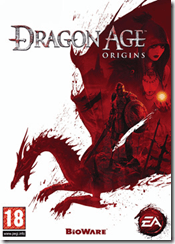

CRPG’s have advanced considerably on this dimension. In the earliest games, there were no fleshed out characters – in Wizardry: Proving Grounds of the Mad Overlord (1981), it was just you as the protagonist (with a back-story and motivations to be provided by the player’s imagination), your party members (who were also custom created by the player and didn’t interact in-game with each other or the protagonist), the arch-villian Werdna (the titular Mad Overlord) and his monsters (the player’s cannon-fodder). This situation had changed by Ultima IV: Quest of the Avatar (1985). The player is given some back-story, and a character development arc (to become more virtuous via ‘good’ deeds). We are introduced to party members, each with their own stories, and who become key staples of the CRPG series going forward (think of them as the ‘ensemble cast’ of a film, the ‘Fellowship’ on its quest). For Ultima players, adventuring with Iolo the Bard, Shamino the Ranger or Dupre the Paladin is a familiar and integral part of the experience. By installments V and VI, the party could interact with NPCs (non-player characters – equivalent to the ‘bit parts’ of a movie); they don’t just exist to provide information to the player or send the party on mini-quests, but they each also have back-stories, daily routines, etc.
BioWare amped up character development for its series of games, especially for party members. In Mass Effect (2007), party members are fleshed out with thousands of lines of professionally voice-acted, branching dialog; they have complex back-stories; and the party members can respond differently to the protagonist depending on whether the player does things of which they approve. In Dragon Age: Origins (2010), the party members also banter between each other (providing some of the best humor in the game), and the game is engineered so that the player spends a lot of time adventuring with and exploring the back-stories of at least a few of the party members. The characters are archetypal fantasy fare, but the writers have taken care to ensure they are not one-dimensional, and that they develop over the course of the game (which the player can also influence). For example, there’s Alistair, the wise-cracking warrior jock who is revealed to be the bastard son of the King and therefore the heir, but doesn’t have a sophisticated or political bone in his body – would he make a good King? Or there’s Leliana, the foreign nun with a veiled and bloody past – will she affirm her new faith, or realize that being an assassin-spy is in her veins? The game succeeds when the player likes (or dislikes) certain characters, which then renders the plot choices towards the end of the game more meaningful and interesting – e.g. when deciding whether to install Alistair on the throne, etc.
Theme
The first CRPGs could be classed as ‘dungeon-crawls’, the theme of which, should they be said to have one, was that to overcome ‘evil’ (represented by a power-mad sorcerer at the bottom of the dungeon), you need to engage in heroic feats of perseverance and planning. This doesn’t sound very exciting or enticing, and indeed Wizardry’s co-creator Andrew Greenberg was known to have remarked that playing through the game was really not that different from adjusting cells and formulae on a spreadsheet, except that the spreadsheet was presented in a slightly different way. As further evidence of a lack of theme, characters/ party members could be ‘good’ or ‘evil’ (borrowing from a simplified Dungeons & Dragons alignment system), but the only difference this makes in-game is which ‘class’ the characters could be, and which other party members they could adventure with (‘good’ characters would not hang with ‘evil’ characters, even though the rest of the game and the story was identical whether or not you controlled a ‘good’ or ‘evil’ party.)
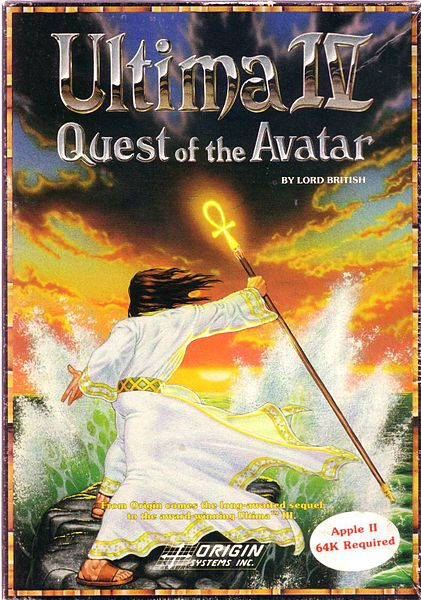
The Ultima series represented the first commercially successful exploration of more compelling themes. In Ultima IV: Quest of the Avatar (1985), the ultimate goal is not the defeat of a tangible evil arch-villain, but overcoming evil and apathy dwelling within all by demonstrating the eight Virtues – Honesty, Compassion, Valor, Justice, Honor, Sacrifice, Spirituality and Humility – and by so doing, become the Avatar and lead the peoples to enlightenment. It’s a discourse on moral philosophy in game format. In Ultima V: Warriors of Destiny (1988), the series explores moral absolutism, fundamentalism and totalitarian dictatorship as a corrupting force takes those Virtues and radically twists them, e.g. if citizens fail to give to charity in ‘Humility’, they are executed by the government. And in Ultima VI: The False Prophet (1990), the thematic focus is on racism, prejudice and reconciliation between two seemingly opposing cultures.
Since these seminal works, stories in later CRPGs have branched out into additional areas, either as primary or sub-themes, from love and romance to loss, revenge, forgiveness, redemption, amnesia/ memory and beyond.
Setting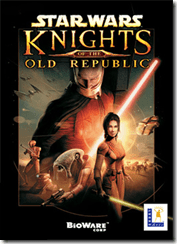
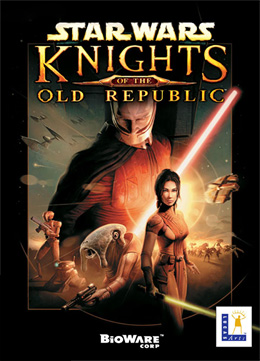
CRPG settings have tended towards fantasy (Tolkien derivative) or sci fi (space opera or cyberpunk), likely influenced first by the early tabletop RPGs such as Dungeons & Dragons (1974). At first, constrained by the limited memory and storage space of early computers, the settings were rudimentary and presented in broad brushstrokes, relying on generic fantasy tropes – e.g., a dungeon, monsters, and an evil wizard waiting at the end (Wizardry: Proving Grounds of the Mad Overlord (1981)). As computer power increased, more and more immersive settings with elaborate back-stories and detailed mythologies could be created (along with better 2D and later realistic 3D graphics) – and many of the CRPGs followed their novel counterparts by spawning series, such as Ultima, Final Fantasy, Elder Scrolls, Mass Effect.
After the first decade, CRPGs experimented with less conventional settings, including apocalyptic wastelands (Wasteland (1988)), bizarre dimensional planes (Planescape: Torment (1999)), and even modern day city streets over-run by gang violence (Grand Theft Auto (1997)).
It’s interesting to note that for the most part, the most successful games did not use settings from well-known mainstream works (such as Tolkien’s The Lord of the Rings (1954), Herbert’s Dune (1965), or Roddenberry’s Star Trek (1966)). While they were for the most part heavily derivative of the better known works, they were originally created for the games, or adapted from niche sources (e.g. Baldur’s Gate (1988) which was set in the Forgotten Realms milieu of Advanced Dungeons & Dragons 2nd Edition). We can speculate as to why that is the case: perhaps license owners of the mainstream settings were not aware of CRPGs, or they were but chose lower-quality studios to develop games, and/or placed such onerous restrictions on the content that it was impossible to furnish a playable game (such as that events in the game had to mirror those of the book or movie – which makes it difficult to plot a game storyline where the player’s choices matter).
The one exception is Bioware’s Star Wars: Knights of the Old Republic (2003). Notably, this is set thousands of years before the six feature films, which gave Bioware license to flesh out an expansive setting which could capture some of the fun of Star Wars (e.g. Jedi knights, light sabers, throwing people and things around with the Force, etc.) while providing enough space to fashion a compelling branching storyline with a new set of interesting characters.
Style and Tone

Consistent with the typical high or dark fantasy setting, the style and tone of CRPGs have tended towards the serious, and the graphics (once computers were powerful enough) towards the realistic – using the same design aesthetic as say Peter Jackson’s film adaptations of The Lord of the Rings (2001-3). Presumably, this reflects the target demographic of the first generations of CRPGs – teenage boys and young men.
The Mass Effect series (2007-) is a good recent example. Though at its heart a B-sci fi yarn in the tradition of Babylon 5 (1993-1998), the style is an effective mix of grand space opera and noir cyberpunk, with a dash of humor (e.g. after introducing the Hanar, sentient jellyfish which communicate in overly long sentences with scrupulous precision and extreme politeness, you can find in-game advertisements for Hanar readings of Shakespeare’s Hamlet), and even satire (e.g. you can come across shady drug peddlers who try to get you addicted on computer games …)
There have been attempts at mixing up the style and tone, such as the more whimsical, cutesy, Japanese anime-like graphics and dialog in the Zelda series (carried to its extreme by The Legend of Zelda: The Wind Waker (2002)). And since Paper Mario (2000) is set in the land of Mario, Luigi, Peach and Bowser, it looks and feels like a children’s cartoon.
Where to from here?
The history of CRPGs shows that storytelling is alive and well within the realm of computer games – though they now need to have a new twist to fit the medium (e.g. branching plots). I’m sure during this generation someone will develop a computer game that will one day be compared with a Shakespearean play, an Austenian novel, or a Wellesian film – but for now here’s some ideas for how CRPGs can further improve their storytelling power:
- Plot: Keep working on branching storylines with meaningful player choices and consequences. It may get so complicated that someone will need to develop an AI to help keep track of the different plot choices and dynamically build or interpolate plots in between ‘broad brushstrokes’ set by the designer.
- Structure: Don’t worry about getting fancy with structure just yet, e.g. frequent jumping around in time, different character viewpoints, etc. It doesn’t help the player connect with the protagonist and the characters – which brings us to –
- Characters: Do keep working on fleshing out and developing characters (at least the key characters in the story), ensuring they are three-dimensional, and that they have a development arc. Again, someone may need to develop an AI who can take a character template with little data, and fill it in with something believable.
- Theme: Don’t be afraid to work with big, philosophical themes (especially those that can come alive for the characters you’ve created) – players of CRPGs are intelligent and educated, and we are well beyond the ‘dungeon crawl’ or ‘hack and slash’ era of computer adventures.
- Setting: With the generation that grew up on Tolkien, Star Wars and comic books now in charge of things, fantasy and sci-fi are now mainstream and mega-bucks – so it’s no longer urgent to find less genre-specific settings to have a wide appeal. Though it’s always cool to see interesting twists on tired old settings …
- Style and Tone: Experiment with fun styles and tones other than the straightforward serious ‘make-believe this is reality’ of high fantasy (though there’s a time and a place for that too!)
Finally, this article has been focused on CRPGs, which is one genre of computer game – what can we learn about storytelling and how that can improve the gameplay, experience and memorability of other types of games, e.g. social games, casual games, shmups (arcade shoot-em-ups), first-person shooters (FPS), real-time-strategy (RTS), etc.? Well, that’s another whole article …
Discussion topic: What do you think a computer game would look like, that would one day (maybe hundreds of years hence) be compared in terms of literary merit with a Shakespearean play or an Austenian novel?
——- *** +++ *** ——-
Appendix: Ten notable story-driven CRPG’s over 30 years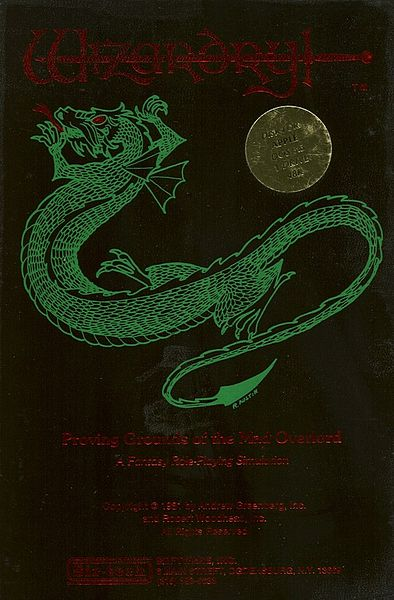
In chronological order:
- Wizardry: Proving Grounds of the Mad Overlord (1981) – for being the first financial successful adaptation of a D&D-like ‘dungeon crawler’ system as a graphical computer game
- Ultima IV: Quest of the Avatar (1985) – for its different plot and theme – a (mostly) peaceful striving for moral perfection; and for introducing party member-characters who have their own personality and reappear in later installments
- Ultima V: Warriors of Destiny (1988) – another non-‘traditional’ theme: tackling fundamentalism, moral absolutism and totalitarianism, with the most gripping adventure story of this ‘second trilogy’ of Ultimas
- Ultima VI: The False Prophet (1990) – again, for its innovative plot and theme (for a computer game): overcoming prejudice and making peace, not war
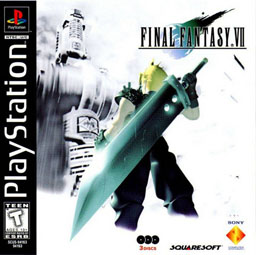
- Final Fantasy VII (1997) – for its sky-high production values, musical score and CGI which made it look and feel like a Hollywood movie on a console/PC
- The Legend of Zelda: Ocarina of Time (1998) – for its innovative 3D graphics and real-time control system, time-travel story structure, and getting the player to connect with the key NPCs (non-player characters) through cute interactions and quests
- Baldur’s Gate II: Shadows of Amn (2000) – for its exhaustive emphasis on story, dialogue, replayability options (like its 1998 predecessor), but also beginning to explore how player choices can shape the plot, relationships with party member-characters, etc.
- Star Wars: Knights of the Old Republic (2003) – for successfully translating a well-loved movie property to games (who doesn’t want to wield lightsabers?), and taking Baldur’s Gate II’s plot choice innovations to the next level: whether you become a good Jedi or evil Sith depends on your in-game actions
- Mass Effect (2007) – takes the core Knights of the Old Republic gameplay in a new direction by successfully merging with a fun near-real-time FPS (first person shooter) combat system, plus great tongue-in-cheek world-building
- Dragon Age: Origins (2010) – as the ‘spiritual successor’ to Baldur’s Gate, it is the best example of deep, interesting, well-rounded characters and an intricate plot choice system where your decisions matter because you care about those characters …

 WetWareGames
Jen DW
June 3, 2011 at 09:36
Some of my local friends have started a digital interactive fiction company: http://www.choiceofgames.com/
They have a blog where they discuss storytelling and other issues around digital games, which you may find interesting.
Jokersmiley
June 3, 2011 at 12:40
Thanks for the tip, Jen, I’ll check them out!